When Critique Ignores Framework: Part 2 - On Reception and Transmission of Rays in Traditional Astrology

For the weekend, I registered for an online event, and the opening discussion about disagreeing or critiquing essential dignities and Hellenistic astrology brought me back to a question that has occupied my mind for some time: what happens to astrology when we remove the distinction between conditions that are supportive and those that are difficult?
For a long while, I have considered the abandonment of essential dignities to be one of the more consequential developments in modern times. Essential dignities, besides being a technical classification of planetary strength, is based on a more fundamental philosophical premise that life contains both ease and difficulty, and that astrology should be capable of describing that distinction.
The assertion that everything is ultimately good, or that every experience can simply be understood as an expression of individual free will, does not adequately explain the variety of human experience. There are circumstances in life that are objectively difficult, undeniably. There are periods of loss, frustration, deprivation and obstruction, just as there are periods of opportunity, flourishing and support. There is no need for astrology to turn suffering into a spiritual virtue in order to give it meaning.
Not every astrologer is a psychologist or therapist, nor should we presume to occupy those roles. As astrologers, we do not know the entirety of a client’s unique personal experience which my friend Joli Knott (https://www.bodhimindful.com) emphasises on a related subject as “being trauma-informed”, and we should be careful not to impose our own interpretation upon it. A difficult planetary condition may describe a period of genuine difficulty, but that does not give the astrologer authority to determine what that experience ultimately means to the person who lived through it.
We can speak about the nature and quality of a period without claiming to know how the native must experience it. The subjective meaning of an experience belongs to the person living it. Our responsibility as astrologers is to educate the client carefully about the unfolding of time: what kinds of circumstances a particular period may signify, where there may be difficulty or support, and how or when the quality of time changes. There is nothing fatalistic about this. It is not our role to paint our own picture over the life of another person, nor to classify their experience as though we possess knowledge of it that they themselves do not.
As far as I am concerned, this is also an ethical reason for retaining the traditional distinction between benefic and malefic conditions and the inherent strength of planets that is known through essential dignities. We can acknowledge that some circumstances are objectively more difficult than others without telling a person what those circumstances must mean to them. Astrology can describe the weather of a period; it does not give the astrologer ownership of the person’s experience of that weather.
I find the traditional distinction between benefic and malefic conditions and dignities more humane because it allows difficulty to be acknowledged as difficulty. A debilitated planet does not need to be transformed into a lesson in order for its symbolism to be legitimate. A difficult placement can describe something that is genuinely difficult in the life of the native. At the same time, traditional astrology gives us techniques for determining when such conditions may be mitigated, redirected or brought to an end. There is something liberating in being able to say that a difficult period is difficult, without imagining that the difficulty itself must somehow be good.
A few months ago, I wrote an article talking about debility and its mitigation. I wanted to return to the subject now in the same nuanced manner to discuss the doctrine of aspects and configurations in Hellenistic astrology, and the transmission of rays or light.
Read the older article here: https://www.aswinsubramanyan.com/post/when-critique-ignores-framework-on-debility-in-traditional-astrology
Given that criticisms of traditional astrology continue to appear, I think it is important that those critiques understand with the actual doctrines of the tradition. Hellenistic astrology does not simply reduce planetary relationships to the modern conception of an aspect. The aspect doctrine relies on configuration; i.e. the geometrical relationships between the planets. Not every planet is necessarily connected to every other planet. This is the foundation of astrology and planetary interaction that allows us to read the chart with more nuance and precision.
If we dive deep into the traditional texts, there is another nuance of planetary influence called the transmission of rays, or transmission of light. This allows one planet to receive and transmit the light of another even when the two planets do not themselves form a conventional Ptolemaic aspect. It is one of those doctrines that becomes interesting if we apply to an actual nativity because it allows us to see how an apparent difficulty can become connected to another, stronger planetary factor.
Nativity of Julia Roberts
To understand this, let us analyse Julia Roberts’ nativity.
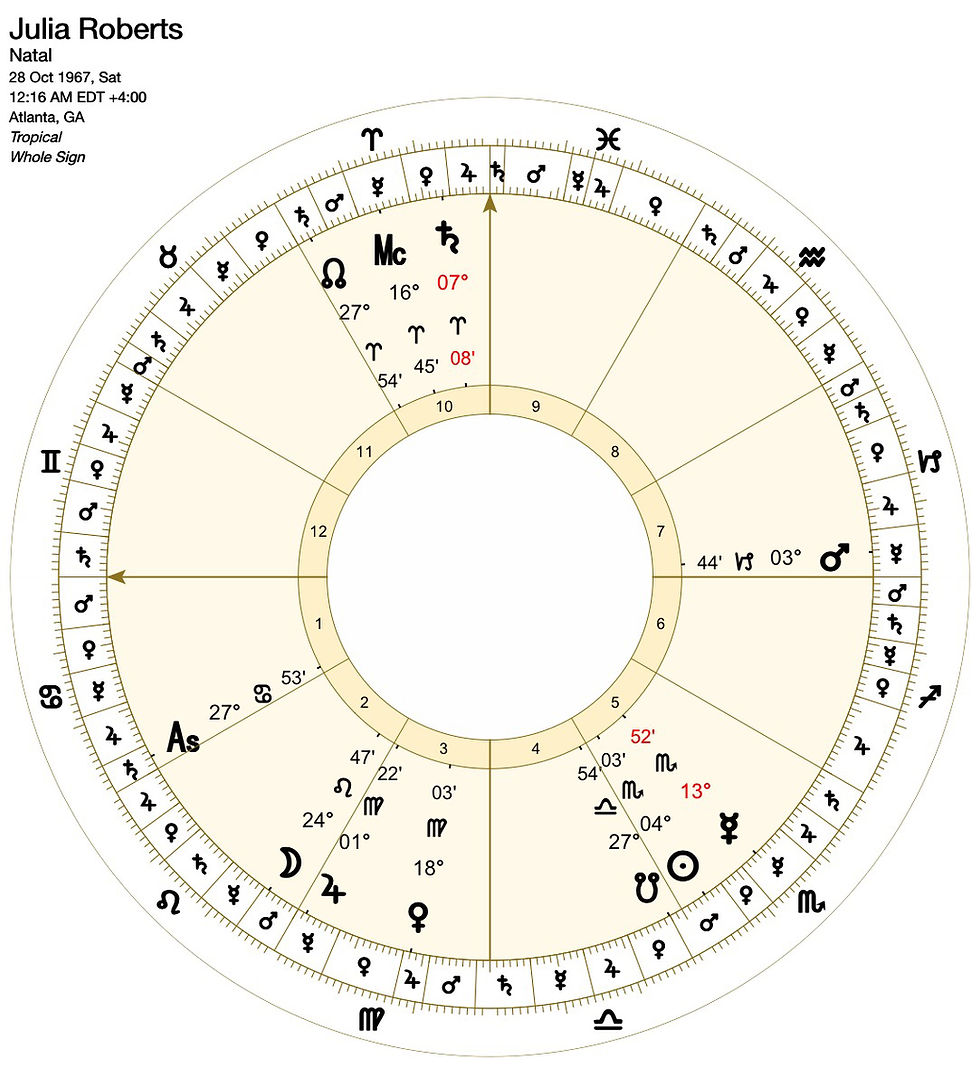
In Julia Roberts’ chart, we can see that Cancer is rising, and Saturn is in the 10th house of Aries, debilitated by fall. The fallen condition of Saturn directly influences or affects the topics of life such as career, reputation and public life. On its own, this can be studied as an indicator of a challenging professional career. But we need to understand that Saturn does not play alone in this chart.
Mars, the ruler of Aries, is exalted in Capricorn in the 7th house. With Saturn placed in Aries in its fall and therefore lacking essential dignity, its ability to function effectively is connected with Mars. Mars, exalted in Capricorn, receives Saturn through a Ptolemaic square. What would ordinarily be described simply as a difficult square also contains reception: Mars receives Saturn into a sign over which it has domicile strength and, because Mars itself is exceptionally strong in the 7th house of Capricorn, provides a means through which the Saturnine condition can be managed and supported. In the Hellenistic tradition, this is termed as “Mitigation”.
Transmission of Rays or Light
While most astrologers understand the concept of a square aspect, even if reception is reasonably familiar, the idea of transmission of rays or light is less widely understood.
Porphyry, in his introduction to the Tetrabiblos of Ptolemy in chapter 17, talks about “Transfer of Nature”.
It is said to be a transfer of nature when one star- applies to another star- and the former again to [still] another; for it conveys the power of the [first] one into the power of the other.
Translation by James Holden
Note that the Sun and Saturn are in aversion from each other but we will now see how the Sun and Saturn connect without actually connecting.
The Sun is the exaltation ruler of Aries and is placed in the 5th house, associated with creativity, pleasure, performance and the arts. If we carefully look at the nativity, we can see the sextile between the Sun and Mars. The Sun connects its significations with Mars, including the themes of creativity, performance and the arts that are prominent through its position in the 5th house.
Mars is also the ruler of the 10th house and is directly responsible for 10th-house topics. An exalted Mars can provide considerable strength to matters of career and public standing, while the fallen Saturn in the 10th can describe the difficulties encountered within those same areas of life.
Note: It would be ideal if the Sun applies to Mars and Mars applies to Saturn.
Moving On
The Sun transmits its light to Mars, and Mars receives that light. Mars is simultaneously in square to Saturn and receives Saturn by domicile. Thus Mars becomes an important intermediary in the configuration. It is a strong planet receiving Saturn and at the same time connected with the Sun and the 5th-house significations.
The point is not that a difficult Saturn somehow ceases to be difficult. The fallen condition of Saturn takes part in a larger configuration in which a stronger planet is capable of receiving it and providing a means of mitigation. Mars connects the professional difficulty represented by Saturn with the creative and performative significations of the Sun in the 5th.
A delineation that considers only Saturn’s fall might produce a genuinely difficult judgment. But if we begin to consider reception, planetary strength, house rulerships and the relationships between the planets, the delination changes considerably. When traditional astrology is criticised for producing a difficult delineation, it is worth asking whether the whole aspect doctrine has actually been applied before ruling out an entire tradition as fatalistic or negative. Usually, critiques won’t apply these nuanced techniques that changes the delineation. Studying texts at a bird’s eye level and engaging in criticism is intellectual dishonest.
The Biography
When Julia Roberts (JR) was being considered for Steel Magnolias, she was still relatively unknown. The role of Shelby had originally been associated with Meg Ryan, and JR had to compete with numerous actresses for the part. Herbert Ross, the director, was initially unconvinced by her. Sally Field, however, who was already established and had been cast in the film, advocated for JR. Sally Field’s intervention helped bring JR into the production despite the reservations surrounding her casting. The significance of this unfolding is not simply that JR eventually became successful, but the manner in which the difficulty was resolved.
The obstacle did not disappear by itself. Assistance came through another person who was already established within the profession. The difficult factor (Saturn) in a chart was received by a stronger planetary factor, and that intervention (Mars) ultimately connected JR with a creative opportunity (the Sun) that became enormously consequential for her career.
The same symbolism can be associated with Pretty Woman as well. JR initially secured the role of Vivian, only to lose it when the project changed hands. Garry Marshall subsequently met her despite initially having other possibilities in mind, became convinced that she was right for the part, and restored her to the project.
Again, we are not seeing effortless success. There was an obstacle (Saturn), followed by intervention (Mars), followed by the preservation of the creative opportunity (the Sun). The difficulty represented by the debilitated Saturn does not prevent the career from developing. However, the stronger configuration involving Mars and the Sun provides a mediation through which the difficulty can be mitigated. This is why I find the traditional rulership and aspect doctrine more useful than an approach in which every planetary condition must ultimately be described as positive.
A fallen Saturn in the 10th can be difficult. That does not mean the native is fated to a professional failure and a well read traditional astrologer would never do so. Nor does mitigation require us to pretend that the condition of Saturn was never difficult in the first place. The chart can contain both things at once: a genuine affliction and a genuine mitigation for dealing with it.
The art of interpretation lies partly in understanding how the planetary bodies interact. A planet cannot always be judged separately from the rest of the configuration in which it participates. Essential dignity, reception, configuration, house rulership and the transmission of rays all contribute to the judgment.
This is why the texts matter. Without studying the texts, we can easily end up criticising conclusions that the tradition itself does not actually make. We may think we are judging Hellenistic astrology when we are really judging an incomplete application of it. The responsibility lies with the astrologer to learn the tradition deeply enough to understand not only how to identify an affliction, but also how to recognise its mitigations, its relationships and the circumstances through which it may find expression like how Saturn found its 10th house expression through Mars and the Sun.
Addendum:
After posting the essay, I realised I need to expand on the aforementioned quote from Porphyry’s introduction to Ptolemy’s Tetrabiblos.
What Porphyry is describing is a sequence in which one planet first applies to another and then applies to a third. The first relationship does not disappear when the planet moves on to the next. The planet carries something of the first relationship into the second, thereby connecting two planets that do not necessarily have a direct relationship with one another. This is the basic logic behind what Hellenistic astrology would commonly describe as the translation or transference of light.
The important feature here is the planet in between (Mars) which I want to call as transmitter of rays as it is true to the tradition. We cannot use the words intermediary or interference here because it refers to a different concept again from Porphyry which I will discuss in one of the future posts. We need to very careful about the words we use since it might easily mean something else.
Imagine, for example, the Moon applying first to Mars and then to Jupiter. The Moon has a direct relationship with Mars and subsequently carries the influence of that relationship to Jupiter. Mars and Jupiter do not need to be directly configured with one another for the Moon to connect their significations in this way. The moving planet becomes the vehicle (transmitter) through which the relationship is transferred.